
Construction timecard tracking: what chasing timecards costs each week
 Erica Garman, PresidentOctober 21, 20266 min read
What to take away
Chasing timecards is office payroll spent where no job picks up the cost.
A missing punch costs more than the minutes it takes to fix.
Run your own crew size and minutes through the math before you buy anything.
Check punches midweek so Friday is only the pay run.
Where the Friday chase hides
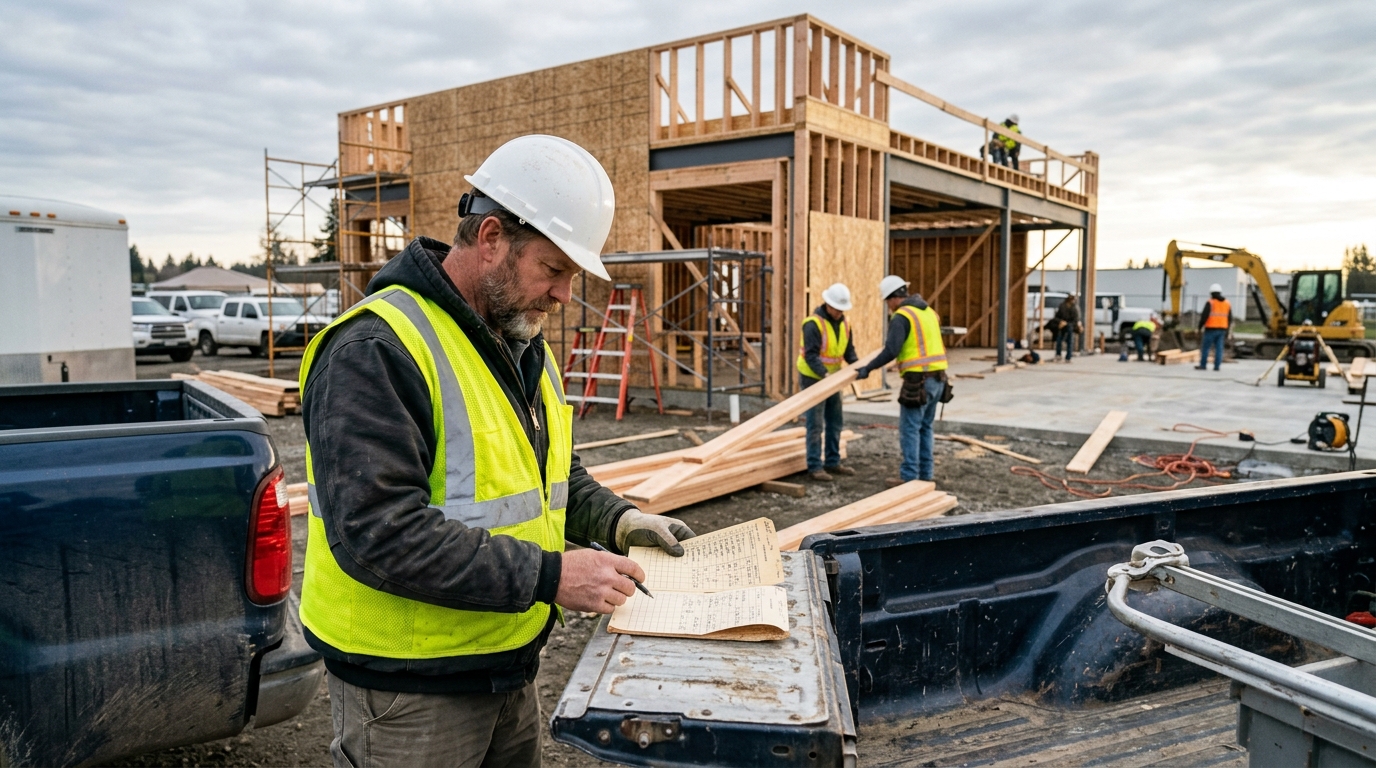
Friday starts out fine. By noon the office has a list of names. A foreman forgot to submit. A laborer texted a photo of a paper card. An operator split the day between sites and logged only the last. Each of those is a small job. Together they eat the afternoon.
The time goes to the same few places:
- Texting foremen for cards that never came in
- Reading handwriting and guessing the job code
- Splitting a shared day between jobs from memory
- Typing paper hours into the payroll system
Friday is a poor day to find a missing punch. The crew has gone home and the cutoff is close. A foreman asked on Friday about Tuesday may offer a guess, and the guess goes into the pay run.
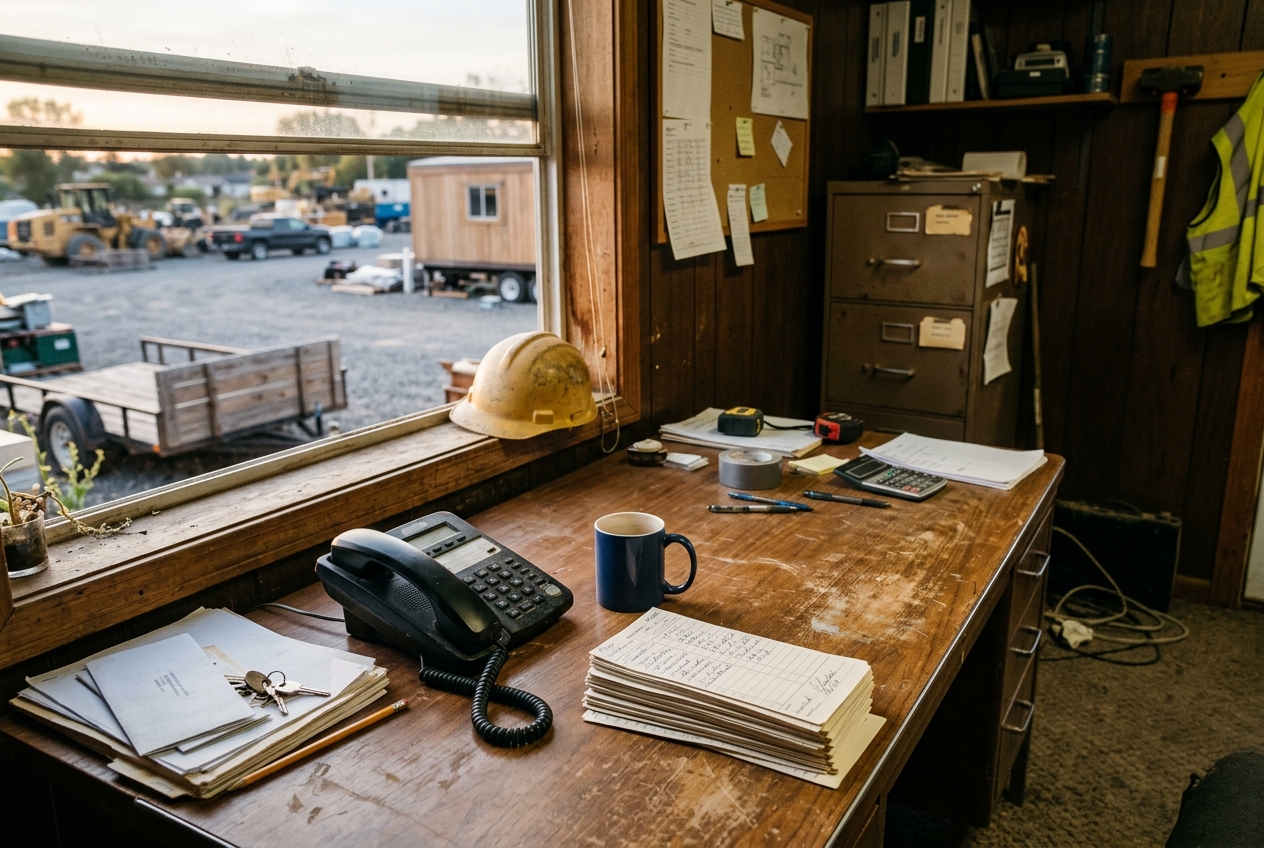
None of this shows up on a job cost report. It sits in overhead, paid for by every job and owned by none. The office manager or the payroll clerk does the chasing. Payroll and timekeeping clerks earned a median of $27.99 an hour at specialty trade contractors and $25.69 an hour at building construction firms in May 2025.
$51.96
An hour in total compensation, private construction employers (BLS, June 2026)
$36.73
An hour in total compensation, office and administrative support workers at private employers (BLS, June 2026)
26 min
Per employee in the last fiscal year fixing missing and incorrect time punches (EY survey, December 2022)
Putting a weekly price on the chase
Use your own numbers wherever these differ from yours.
Worked example: Assume 40 field employees. Assume the office spends 0.25 hours per employee each Friday chasing timecards. 40 x 0.25 hours = 10 hours. In June 2026, private employers paid office and administrative support workers $36.73 an hour in total compensation. 10 hours x $36.73 = $367.30 a week.
Total compensation is the right rate because taxes and benefits ride along with every hour. For office and administrative support workers, total compensation ran 1.46 times wages in June 2026.
Run the math with your own crew size. If your office takes longer per card, the figure grows. If your foremen submit on time, it shrinks.
What published numbers say about timecard errors
An EY survey of 508 payroll workers at U.S. companies with 250 to 10,000 employees, released December 2022, found that companies spent 26 minutes per employee in the last fiscal year fixing missing and incorrect time punches. The EY survey found a payroll error cost an average of $291. The EY survey also counted 1,139 time/attendance and expense errors per 1,000 employees per year, costing about $250,000 per 1,000 employees per year. Use those figures as a yardstick for your own shop, not a forecast.
Field hours carry a price too. In June 2026, private construction employers paid $36.13 an hour in wages and $51.96 an hour in total compensation. A crew hour booked late, or booked to the wrong job, leaves that cost sitting in the wrong place.
Here is how the same week looks with and without a midweek check.
| Problem | Chasing on Friday | Checking during the week |
|---|---|---|
| Missing punch | Found after the crew leaves the site | Flagged while the day is still fresh |
| Wrong job code | Guessed from memory or a photo | Corrected by the foreman the same day |
| Who does the work | Office manager or payroll clerk | Foreman, with a quick office review |
| Payroll run | Waits on the last card | Starts from a clean list |
A weekly rhythm for construction timecard tracking
You do not need a new routine every day. You need a gap list before payday.
- 01Ask each foreman to submit hours at day's end, from the truck if needed.
- 02Have the office build a gap list on Wednesday: names with no hours, hours with no job.
- 03Send each foreman a single message with that foreman's gaps, not a string of texts.
- 04Let the foreman confirm or correct the entries by Thursday.
- 05Run payroll on Friday from a list that is already clean.
A tool can build the gap list from the hours already entered. The office manager still reads it, and the foreman still confirms the entries. Nobody has ever missed a Friday payroll because the list was too clean.
Start with a crew that always runs late. Fix that crew's habit, then widen the routine.
Questions people ask
How do I find my own cost of chasing timecards?
Count the minutes your office spends on each employee's card, multiply by crew size, then price the hours at the office rate. Use total compensation instead of wages as that rate. The worked example above shows the arithmetic.
Is a payroll error really that expensive?
It can be. The EY survey put the average payroll error at $291. Add the office time spent finding the cause and the cost grows.
Who should chase late timecards, the foreman or the office?
The foreman should confirm hours, because the foreman knows where the crew worked. The office manager reviews the gap list and follows up only on what is still open.
Does a smaller crew still lose time to chasing?
Yes, because the work follows the number of cards, not the size of the company. A small shop has fewer cards but fewer hands to chase them, so the owner often ends up doing it.
Keep reading
All articles →Cash Flow & Financing
Why your change orders take two weeks to hit the books
The delay is almost never the accountant. It’s the four handoffs between the foreman’s photo and the invoice line.
Tools & Tech
The real cost of re-keying the same number three times
Double entry isn’t just wasted hours – it’s the reason two reports never agree and nobody trusts either one.
Tools & Tech
What to ask before you sign another software contract
Six questions that surface the implementation cost vendors leave off the quote.
